
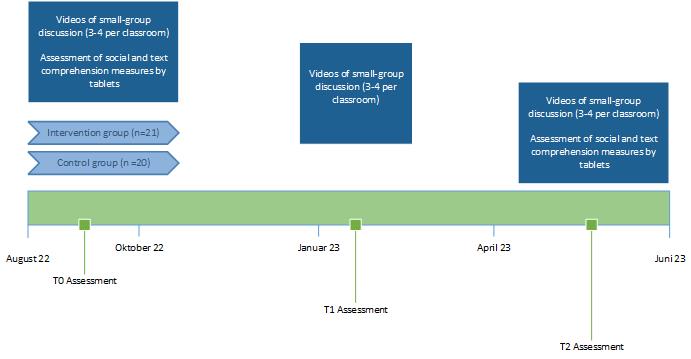
In the SKiLL study, 41 classes were randomly assigned to either an intervention group (IG) or a control group (CG). Children and teachers in the IG received training on two afternoons, during which they learned how to support student-centered discussions. Teachers assigned to the CG continued their German lessons as usual.
To test the effectiveness of the program, tests were conducted at the beginning of the school year (before the program started), in the middle of the school year, and at the end of the school year (after the program ended). On the one hand, small group discussions about a text were videotaped, and the children wrote a short essay on an ethical dilemma. On the other hand, the children worked on tablets on tasks related to reading comprehension, perspective taking, moral courage, attitudes toward foreign groups, and friendships.
The analyses revealed the following:
Among the teachers ...
- After completing the SKiLL program, IG teachers showed greater emotional support (e.g., positive atmosphere, consideration of the children's perspective) and learning support (e.g., promotion of deeper understanding) than KG teachers.
- Teachers in the IG were better able to hand over control of the conversation to the children after the program. They intervened less, and when they did intervene, they used so-called talk moves to support the argumentative quality of the conversation (e.g., “Why do you think that?”, “Would anyone like to add to what Larina just said?”, “Can this problem also be viewed differently?”).
Among the children ...
- The children in the IG were more engaged in the conversations than the children in the CG.
- Children in the IG demonstrated a higher quality of argumentation in the conversations. Their answers showed more reasoning, more constructive responses, and more critical thinking.
- Through the SKiLL intervention, children in the IG developed a greater ability to take on different perspectives, more positive attitudes toward outgroups, and greater moral judgment than children in the CG.
- For children in the IG, self-perceived dialogical competence played a central role in the increase in dialogical skills. Children who felt more competent at the beginning of the intervention and whose sense of competence increased more strongly during the intervention showed a greater increase in their dialogical skills over the course of the school year.