
12.09.2026
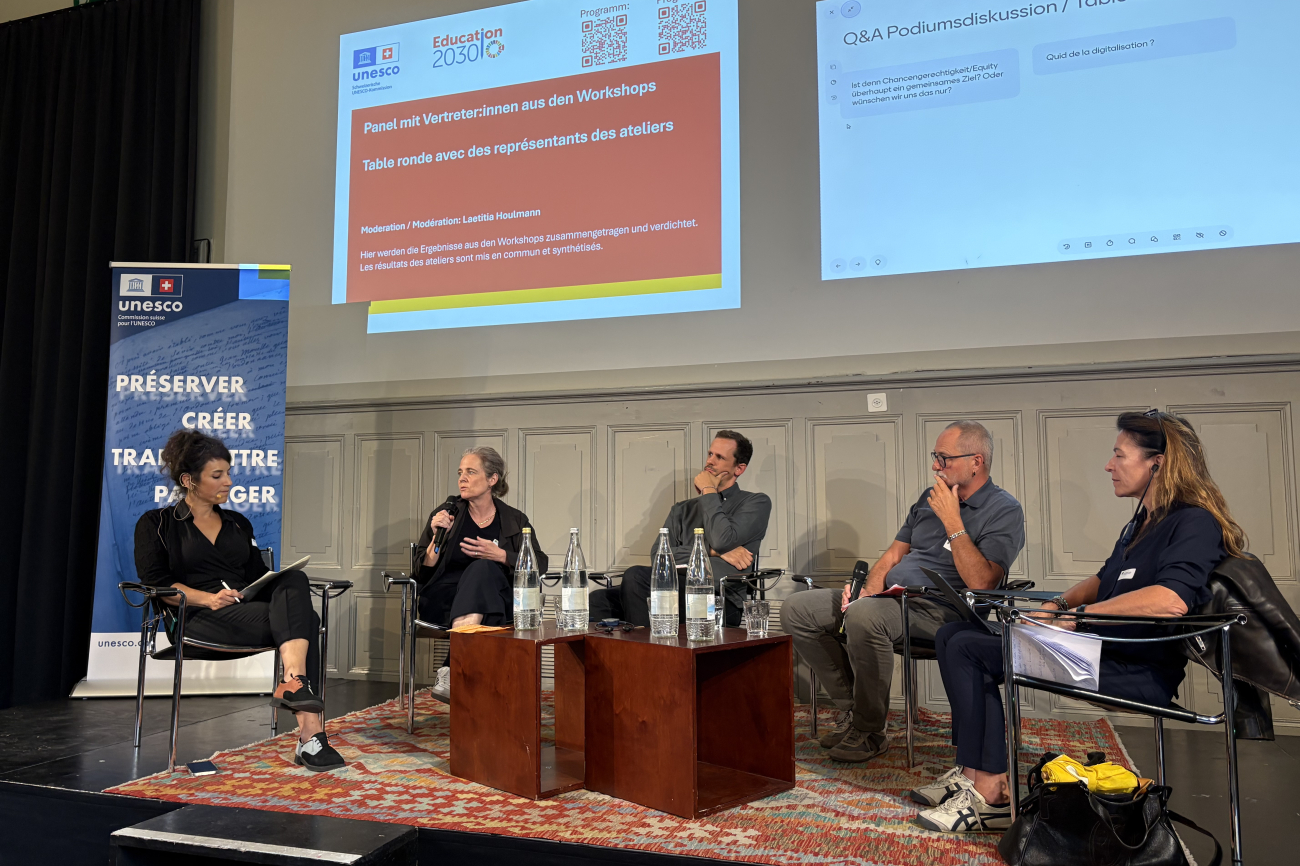
On 9 September 2026, the Swiss UNESCO Platform for Education 2030 focused on equity in education. Caroline Sahli Lozano, Head of the research programme on Inclusive Education at PHBern, led a workshop on tertiary education and contributed its findings to the concluding panel discussion.
Three expert presentations, drawing on international findings from the UNESCO Global Education Monitoring Report 2026, the latest data from the Swiss Federal Statistical Office (FSO) and findings from the Swiss Education Report 2026, provided the basis for subsequent discussions on existing educational inequalities and ways to improve access to high-quality education for all. The workshop on tertiary education focused particularly on the role of universities of teacher education in promoting equity.
Educational inequalities in tertiary education
The workshop on tertiary education explored the findings in greater depth, focusing on access to higher education. The evidence discussed highlighted that access to tertiary education continues to be strongly influenced by social background and regional factors. Educational inequalities do not arise only when students enter higher education. Rather, they are often the result of selection processes and unequal educational opportunities that become increasingly pronounced across different educational stages and transitions.
Particular attention was paid to universities of teacher education, where the majority of students are female. At the same time, patterns of selective access can be observed in relation to region, social background and migration background.
This raises questions not only about equitable access to higher education, but also about how universities of teacher education respond to the diverse circumstances, experiences and educational pathways of their students.
Universities of teacher education have a dual responsibility in this regard. On the one hand, they must continuously develop their own institutional cultures, structures and practices to promote diversity and equity. On the other hand, they prepare future teachers to recognise educational inequalities, respond professionally to diversity and collaborate effectively with professionals from different disciplines. The connection between institutional development in higher education and teacher education is therefore crucial.
Inclusive education as a shared responsibility
The discussions also highlighted the close links with UNESCO's Education 2030 Agenda and Sustainable Development Goal 4 (SDG 4), which aims to ensure inclusive and equitable quality education for all.
Teachers play an important role in this endeavour, as they can make a significant contribution to reducing educational inequalities, enabling participation and creating inclusive learning environments. At the same time, appropriate structural conditions and the continuous development of teacher education are essential.
At the end of the event, the findings from the workshops were brought together in a panel discussion. Caroline Sahli Lozano highlighted two key areas of connection: collaboration across different levels of education and dialogue between research, educational practice and education policy and governance.
Organised by the Swiss Commission for UNESCO, the Swiss Platform for Education 2030 provided a valuable opportunity to discuss current findings, bring together different perspectives and identify shared challenges. One key message was that educational inequalities cannot be addressed in isolation within individual levels of education. Strengthening equity in education in the long term requires both developments within individual educational sectors and closer collaboration across institutional boundaries.
Further information about the Swiss Platform for Education 2030 and the event programme is available on the website of the Swiss Commission for UNESCO.
Further links: