
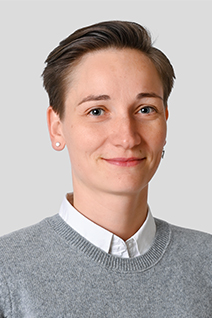
Prof. Dr. Katharina Bernecker
Leiterin Zentrum für Forschungsförderung
+41 31 309 22 13
- Rolle von Selbstregulation in Gesundheit und Wohlbefinden
- Motivationale und kognitive Prozesse erfolgreicher Zielverfolgung
Motivationale Determinanten von Konfliktverhalten in romantischen Beziehungen
- 2011–2015 Dr. phil. in Psychologie, Universität Zürich, Titel: "Implicit Theories about Willpower and Their Consequences for Achievement, Health and Well-Being"
- 2009–2011 M. Sc. Psychologie, Universität Erfurt
- 2005–2008 B. A. Lehr-, Lern-, und Trainingspsychologie/Erziehungswissenschaften, Universität Erfurt
- Seit 2024 Leiterin Zentrum für Forschungsförderung (ZFF), Instituts für Forschung, Entwicklung und Evaluation (IFE), PHBern
- 2019–2026 Oberassistentin ad personam, Allgemeine Psychologie (Motivation), Universität Zürich
- 2017–2019 Postdoktorandin, Leibniz-Institut für Wissensmedien (IWM) Tübingen
- 2015–2017 Postdoktorandin, Allgemeine Psychologie (Motivation), Universität Zürich
- 2011–2015 Doktorandin SNF Ambizione, Universität Zürich
Seit 2023 Member-at-Large im Executive Council der Society of the Science of Motivation (SSM)
Gewähltes Amt für die Dauer von 2 Jahren, Wiederwahl erfolgte Mai 2025
2024 & 2025 Mitglied der Wahlkommission der Society for the Science of Motivation
Verantwortlich für die technische Durchführung der Wahl
2022 – 2025 Initiatorin und Organisatorin Network-Events für Postdoktorierende
Initiative zur Förderung der institutsweiten Vernetzung, Psychologisches Institut, UZH
2019 – 2026 Organisatorisches Leitungsteam PASEZ-Projekt
10-jähriges vom SNF gefördertes Forschungsprojekt «PASEZ-Partnerschaft und Stress im Zeitverlauf» mit 360 Schweizer Paaren; Initiatorin und Verantwortliche für die Veröffentlichung der Daten auf SwissUBase
2018–2019 Sprecherin des SAW Postdoc-Network "Cognitive Conflicts in Digital Media Use"
Gewähltes Amt am Leibniz-Institut für Wissensmedien, Tübingen
2018 – 2019 Vertreterin Postdoktorierende im Leitungsgremium
Gewähltes Amt am Leibniz-Institut für Wissensmedien, Tübingen
- Mitglied Schweizer Gesellschaft für Psychologie (SGP)
- Mitglied Deutsche Gesellschaft für Psychologie (DGPs)
- Mitglied Society for the Science of Motivation (SSM)
- Mitglied bei der European Association of Social Psychology (EASP)
Eingeworbene Drittmittelprojekte
2021-2025 Forschungsprojekt, Schweizerischer Nationalfond (SNF), «How to eat your cake and enjoy it, too – Examining determinants of successful hedonic goal pursuit» (10001C_197635), PI: Dr. Katharina Bernecker
Dauer: 36 Monate, abgeschlossen, Fördersumme: CHF 365'142 (€ 339'753)
2017-2019 Forschungsprojekt, Senatsausschuss Wettbewerb (SAW), Leibniz-Gemeinschaft, «No Pain, No Gain? Investigating Motivational Effects of Game Elements in Cognitive Tasks», PI: Dr. Katharina Bernecker, Dr. Manuel Ninaus
Dauer: 16 Monate, abgeschlossen, Fördersumme: € 9'012
2013-2014 Forschungsprojekt, Suzanne und Hans Biäsch Stiftung für die Weiterentwicklung der Angewandten Psychologie, «Wie soll ich das nur alles schaffen? Wie Laientheorien über die eigene Willenskraft das subjektive Wohlbefinden und körperliche Gesundheit beeinflussen“, Antragstellerin/PI: Katharina Bernecker, M.Sc.
Dauer: 7 Monate, abgeschlossen, Fördersumme: CHF 45'500 (€ 42'342)
Forschungskooperationen mit der Praxis
Seit 2023 Forschungskooperation mit Sucht- und Rehabilitationsklinik Salus-Klinik GmbH & Co. Hürth KG zur Evaluation eines Genussbasierten Rehabilitationsansatzes bei Suchterkrankungen; Kooperationspartnerinnen: Nadia Bouraoui, Dr. Katrin Grümer
Seit 2021 Forschungskooperation mit Universitätsspital Zürich, Arbeitsgruppe «Addictive Disorders» zur Veränderung von Genussfähigkeit durch Neurofeedbacktraining bei Personen mit Kokainabhängigkeit, Kooperationspartnerin: Anna Trippel, M.Sc.
2021 – 2022 Forschungskooperation mit Sucht- und Rehabilitationsklinik im Wingert zur Weiterentwicklung Skala Genussfähigkeit zum Einsatz bei Suchterkrankungen, Kooperationspartner*innen: Dipl.-Psych. Axel Schmidt, Dipl. oec. troph. Annika Backes
2021 – 2022 Forschungskooperation mit Witty Works AG zur Entwicklung und Evaluation einer künstlichen Intelligenz für inklusive Sprache, gemeinsamer Antrag bei InnoSuisse; Kooperationspartner*innen: Prof. Dr. Mirka Henninger, Nadia Fischer, Lukas K. Schmidt
2017 – 2021 Forschungskooperation mit Universitätsklinikum Tübingen zur Entwicklung einer Applikation zur Behandlung von Arthrose, Kooperationspartner*innen: Prof. Dr. Inga Krauß, Prof. Dr. Gorden Sudeck, Prof. Dr. Kai Sassenberg
2025
Bernecker, K.*, Becker, D., Guobyte, A., & Ganama, D. (2025, October). ‘Pleasureful self-control’? A new perspective on old problems. Fachgruppentagung Sozialpsychologie, Bochum, Germany.
Bernecker, K.*, Becker, D., & Guobyte, A. (2025, September). High self-control individuals prefer meaning over pleasure. 18th Conference of the Swiss Psychological Society (SPS), Crans-Montana, Switzerland.
Bernecker, K.*, Becker, D., & Guobyte, A. (2025, July). High self-control individuals prefer meaning over pleasure. CERE 2025, Grenoble, France.
Bernecker, K.*, Becker, D., & Guobyte, A. (2025, May). High self-control individuals prefer meaning over pleasure. 2025 APS Annual Convention, Washington, D.C., USA.
2024
Bernecker, K.*, Becker, D., & Guobyte, A. (2024, September). The Motivational Dimension of Self-Control? Preference for Meaning Over Pleasure. DGPs Conference Vienna, Austria.
Bernecker, K.*, Becker, D., & Guobyte, A. (2024, September). The Motivational Dimension of Self-Control? Preference for Meaning Over Pleasure. DGPs Conference Vienna, Austria.
Bernecker, K.* (2024, September). Understanding Processes of Goal Pursuit: Progress and Challenges. Invited discussant for symposium. DGPs Conference Vienna, Austria.
2023
Schäfer, J.*, Brandstätter, V., Hennecke, M., Koch, M., Pfister, M. & Bernecker, K. (2023, October). High Voltage! Do Not Touch? Touch as Goal-Directed Behavior and a Buffer for the Emotional Impact of Negative Relationship Events. Motivationspsychologisches Kolloquium (MPK), Jena, Germany.
Becker, D.*, & Bernecker, K. (2023). “Happy Hour”: The relationship between hedonic capacity and motivation to drink alcohol. 19th General Meeting of the European Association of Social Psychology (EASP). Krakow, Poland.
Bernecker, K.*, Becker, D., & Guobyte., A. (2023). Hedonic goals guide attention to enjoyable stimuli and thereby foster hedonic success. 19th General Meeting of the European Association of Social Psychology (EASP). Krakow, Poland.
Guobyte., A.*, Bernecker, K., Becker, D. (2023). Blended goals: Consequences of mixing work into pleasure for hedonic success. 19th General Meeting of the European Association of Social Psychology (EASP). Krakow, Poland.
Guobyte, A.*, Becker, D., & Bernecker, K. (2023, March). Blending goals: Hedonic outcomes of multifinal means. ICPS Congress, Brussels, Belgium.
Bernecker, K.*, & Becker, D. (2023, February). Is pleasure the problem or part of the solution. Moderation of panel discussion, Motivation Science Pre-conference, SPSP Convention, Atlanta, USA.
2022
Bernecker, K.*, Becker, D., Weitkamp, K. & Wehrli, F. (2022, September). Who Experiences Pleasure? Relationships Between Trait Hedonic Capacity, Sexual Pleasure, and Distracting Thoughts. 17th Annual Meeting Swiss Psychological Society 2022, Zurich.
Becker, D.* & Bernecker, K. (2022, September). “Happy Hour”: The relationship between hedonic capacity and motivation to drink alcohol. 17th Annual Meeting Swiss Psychological Society 2022, Zurich.
Guobyte, A.*, Becker, D., & Bernecker, K. (2022, September). Blending goals: Hedonic outcomes of multifinal means. 17th Annual Meeting Swiss Psychological Society 2022, Zurich.
Bernecker, K.*, Becker, D., & Guobyte, A. (2022, July). If the party is good, you should stay longer—effects of trait hedonic capacity on hedonic quantity and performance. European Congress of Personality, Madrid, Spain.
2021
Bernecker, K.*, & Becker, D. (2021, October). Beyond self-control: The ability to pursue hedonic goals. Motivationspsychologisches Kolloquium (MPK). Zurich, Switzerland.
2019
Bernecker, K.*, & Becker, D., (2019, September). The ability to pursue hedonic goals - A necessary counterbalance to the concept of trait self-control? General Meeting of the Swiss Psychological Association (SGP). Bern, Switzerland.
2018
Becker, D.*, Bernecker, K. (2018, December). The ability to pursue hedonic goals - A necessary counterbalance to the concept of trait self-control? Associatie van Sociaal-Psychologische Onderzoekers(ASPO). Nijmegen, Netherlands.
Becker, D.*, & Bernecker, K. (2018, September). The ability to pursue hedonic goals - A necessary counterbalance to the concept of trait self-control? European Social Cognition Network (ESCON). Köln.
Bernecker, K.*, & Becker, D. (2018, June). The ability to pursue hedonic goals - A necessary counterbalance to the concept of trait self-control? 30th Annual Meeting of the Association for Psychological Science (APS). San Francisco, USA.
Bernecker, K.*, & Becker, D. (2018, September). The ability to pursue hedonic goals - A necessary counterbalance to the concept of (trait) self-control? 51. Kongress der Deutschen Gesellschaft für Psychologie (DGPs). Frankfurt am Main.
2017
Bernecker, K.*, Job, V. (2017, July). Beliefs about willpower and sleep procrastination. Preconference “The self-regulation of health”, 18th General Meeting of The European Association of Social Psychology, Granada, Spain.
Sieber, V.*, Flueckiger, L., Bernecker, K., Mata, J., & Job, V. (2017, July). Autonomous goal striving promotes a nonlimited belief about willpower. 18th General Meeting of The European Association of Social Psychology, Granada, Spain.
2016
Brandstätter, V.*, Bernecker, K., & Ghassemi, M., (2016, September). Avoidance motivation, negative (non)verbal communication, and emotional experience in intimate relationships in younger and older age. 50th Congress of the German Psychological Association (DGPs), Leipzig, Germany.
Bernecker, K.*, Ghassemi, M., & Brandstätter, V. (2016, September). "Fahr vorsichtig, Schatz!" – Emotionale Auswirkungen von riskantem Verhalten in (Paar-)Beziehungen. 50th Congress of the German Psychological Association (DGPs), Leipzig, Germany.
Ghassemi, M.*, Bernecker, K., & Brandstätter, V. (2016, August). “Take care, honey”: People are more anxious about their partner's risk behavior than about their own. ESCON Transfer of Knowledge Conference, Lisbon, Portugal.
Bernecker, K.,* Job V., & Hofmann, W. (2016, August). Trait Measures of Self-Control and their Relationship to Experience, Resistance, and Enactment of Desires in Everyday Life. ESCON Transfer of Knowledge Conference, Lisbon, Portugal.
Ghassemi, M.*, Bernecker, K., Herrmann, M., & Brandstätter, V. (2016, May). The process of disengagement from personal goals. Paper presented at the 9th Annual Meeting of the Society for the Study of Motivation (SSM), Chicago, USA.
Bernecker, K.*, Job, V, & Friese, M. (2016, February). Effects of Practicing Self-Control on Academic Performance. Self-Regulation Pre-Conference 17th SPSP Annual Convention, San Diego, USA.
2015
Job, V., Bernecker, K.*, Herrmann, M., & Brandstätter, V. (2015, September). Implicit theories about willpower predict subjective well-being. SSP/SGP Conference, Geneva, Switzerland.
Ghassemi, M.*, Herrmann, M., Bernecker, K., & Brandstätter, V. (2015, September). Should I stop or should I go? Recent findings on the action crisis as a motivational conflict between goal pursuit and goal disengagement. Paper presented at the 14th Biannual Congress of the Swiss Psychological Society (SSP/SGP), Geneva, Switzerland.
2013
Bernecker, K.*, Job, V., Dweck, C.S. & Walton, G.M. (2013, September). Changing lay theories about willpower improves self-regulation under stress.Fachgruppentagung Sozialpsychologie, Hagen, Germany.
Job, V.*, Bernecker, K., & Friese, M. (2013, September). “That was exhausting, I need a break!”: A limited theory of willpower predicts rest-goal-activation following self-control exertion. 13th Congress of the Swiss Psychological Society, Basel, Switzerland.
Bernecker, K.* & Job, V. (2013, August). Implicit theories about willpower predict preference for sugar after self-control exertion. Meeting of the European Social Cognition Network (ESCON), Vilnius, Lithuania.
Job, V.*, Walton, G. M., Bernecker, K., & Dweck, C. S. (2013, August). Beliefs about willpower determine the impact of glucose on self-control. European Social Cognition Network Meeting (ESCON), Vilnius, Lithuania.
Job, V.*, Bernecker, K., & Dweck, C. S. (2013, May). Are implicit motives the need to feel certain affect? Motive-affect congruence predicts relationship satisfaction. 6th Annual Meeting of the Society for the Study of Motivation (SSM), Washington, USA.
Job, V.*, Bernecker, K., & Friese, M. (2013, May). “That was exhausting, I need a break!”: A limited theory of willpower predicts rest-goal-activation following self-control exertion. 25th Annual convention of the Association for Psychological Science (APS), Washington, USA.
2012
Job, V.*, Walton, G. M., Bernecker, K., & Dweck, C. S. (2012, October). Does glucose really boost willpower? Implicit theories vs. glucose as determinants of self-control. Annual Meeting of the Society of Experimental Social Psychology (SESP), Austin, USA.
Bernecker, K.* & Job, V. (2012, September). Exploring the mechanism of implicit theories of willpower. Meeting of the European Social Cognition Network (ESCON), Estoril, Portugal.
Bernecker, K.*, Job, V., Dweck, C.S., & Walton, G.M. (2012, September). Veränderung von Impliziten Theorien der Willenskraft verbessert Selbstregulation unter Stress. [Change in willpower theories predicts better self-regulation under stress.] 48th Annual meeting of the Deutsche Gesellschaft für Psychologie, e.V. (DGPs), Bielefeld, Germany.
Job, V.*, Walton, G. M., Bernecker, K., & Dweck, C. S. (2012, September). Implizite Theorien vs. Glucose als Determinanten von Selbstkontrolle [Implicit theories vs. glucose as determinants of self-control]. 48th Annual meeting of the Deutsche Gesellschaft für Psychologie, e.V. (DGPs), Bielefeld, Germany.
Bernecker, K.*, Job, V., Walton, G.M., & Dweck, C.S. (2012, January). Changing lay theories about willpower improves self-regulation under stress. 13thAnnual Meeting of the Society for Personality and Social Psychology (SPSP), San Diego, USA.