
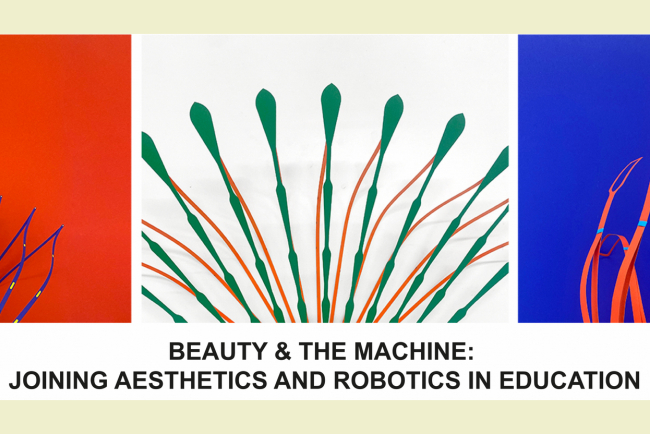
We pursue an educational approach that integrates art and aesthetics into teaching in order to promote creativity and engagement in the field of robotics.
Project description
Starting point
Digital skills are central to education and will become even more important in the future. Educational robots can support the development of these skills in the STEM context by bringing high motivation, cross-curricular skills and interdisciplinary topics into the classroom. Despite these advantages, educational robots are still not widely used in schools, as (prospective) teachers often do not feel connected to this technology or do not have enough confidence to integrate it into their lessons. Numerous research projects are already underway to change this. However, there has been a lack of research into the potential of combining aesthetics and robotics. Studies show that aesthetics can trigger positive emotions – offering great potential for promoting the integration of educational robots in schools, especially among (prospective) teachers.
Our research project closes this gap with three studies that examine the following research question: To what extent does the combination of robotics and aesthetics influence the motivation of prospective and active teachers to integrate educational robots into their digital teaching – especially through positive emotions?
Study A examines the factors that influence the motivation of prospective teachers using qualitative surveys.
Study B examines the effect of the combination of robotics and aesthetics on the motivation and skills of active teachers using an experimental design (workshop and two quantitative surveys).
Study C is an exploratory, quantitative study that investigates how the combination of aesthetics and robotics influences the perception of robotics and STEAM among pupils in compulsory education.
Objectives
Our goal is to develop validated teaching materials that promote teachers' digital motivation and skills. The materials are based on scientific findings on specific factors that increase motivation and skills and exploit the advantages of combining aesthetics and robotics (e.g. stronger positive emotions) to motivate (prospective and practising) teachers to integrate educational robots into their teaching. We intend to disseminate these materials widely — internally and externally — through targeted project communication.
Method
Study A: We use qualitative surveys to thoroughly investigate the factors that influence motivation in this year's study with teacher training students.
Study B: To test the effects of aesthetics and robotics on teachers in the school system, we plan to use the same experimental design as in this year's study with teacher training students. The experimental design includes a workshop as an experimental manipulation and two quantitative surveys.
Study C: In an exploratory study, we want to investigate the effects of combining aesthetics and robotics on primary school pupils' perceptions of robotics and STEM. The study uses a quantitative approach.
Planned translation
The rapid translation of research into practice has been a central element of our project from the outset: we have already developed teaching materials that can be used immediately in teacher training or in the classroom. These materials have been tested by prospective teachers, who have already received a well-designed workshop as part of their participation in the study. To accelerate the transfer, communication experts from the BFH support the exchange with practice partners and disseminate the materials via various channels (e.g. Instagram, LinkedIn, website, ROTECO). The materials are to be made available as open educational resources (OER) in the form of complete packages. Our main goal is to increase the use of educational robots in compulsory school classes. When more teachers use educational robots, learners benefit from practical, motivating and creative teaching experiences. This increases the likelihood that pupils will take an interest in STEAM and possibly choose STEM careers – contributing to combating the shortage of skilled workers in these areas. As a side effect, we also expect to see better representation of robotics in compulsory schools. We plan to measure the impact of our project in three studies in 2026.
Team
- Manuel Bernal Lecina; Group MOBOTS, EPFL Dr. Jan Hofmann; Group MOBOTS, EPFL
- Dr. Verena Huber Nievergelt; Institut Primarstufe, PHBern
- Dr. Julia Mori; Institut für Erziehungswissenschaft, Universität Bern
- Lorenz Möschler; Institut für Weiterbildung und Dienstleistungen, PHBern
- Léa Pereyre; Group MOBOTS, EPFL
- Prof. Jimmy Schmid; Hochschule der Künste Bern, BFH
- Ramona Tschuppert; Hochschule der Künste Bern, BFH
- Urs Wildeisen; Institut Primarstufe, PHBern